

Energy-efficient Air Handling Units for a Wide Range of Applications
Ventilation requirements are as individual as their locations. Airbox air handling units from Rosenberg offer the right energy-efficient solution for every application. Whether simple air exchange or precise control of temperature, humidity and purity – the requirements for ventilation systems vary greatly. The air handling units in the Airbox series have a modular design and can be individually configured, so that the optimal solution for every application can be quickly realised using a modular principle.

Air Handling Units for all areas
of technical building equipment
Whether for high-tech areas or classic building services engineering: Airbox air handling units always ensure clean, optimally tempered indoor air. They are available in weatherproof, explosion-proof and TÜV-certified hygienic designs and meet the energy efficiency requirements of EN 1253/2014 Ecodesign – for maximum economy, quality and flexibility.
Overview of the Airbox Series
The air handling units consist of a frame construction with double-shell sound and heat insulated panels. The individual modules for filters, fans, heaters, coolers, heat recovery, sound insulation and frame materials are flexibly assembled according to customer requirements. The F40 series is manufactured in a frameless design. The panels are screwed together from the outside, so that the units have a smooth interior surface and are therefore hygienically safe. The air handling units equipped with frames (Airbox S60 and T60) feature a frame construction made of aluminium or galvanised rolled steel profile and die-cast aluminium corner connectors or plastic corner connectors.
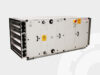
AIRBOX-F40
- Panel thickness: 40 mm
- Frame: frameless design

AIRBOX-S60
- Panel thickness: 60 mm
- Frame: 1.5 mm galvanised steel or stainless steel

AIRBOX-T60
- Panel thickness: 60 mm
- Frame: 1.5 mm aluminium and thermally decoupled
AIRBOX-F40 | AIRBOX-S60 | AIRBOX-T60 | |
|---|---|---|---|
Minimum air volumes (V=1 m/s) | 800 - 5.600 m³/h | 810 - 33.000 m³/h | 810 - 33.000 m³/h |
Optimal air volumes | 1.600 - 11.200 m³/h | 1.610 - 66.000 m³/h | 1.610 - 66.000 m³/h |
Maximum air volumes | 3.200 - 22.400 m³/h | 3.200 - 132.100 m³/h | 3.200 - 132.100 m³/h |
Heat transfer [W/m²K] | 1,0 (T2) | 1,00 (T2) | 0,70 (T2) |
Thermal bridge factor kb | 0,5 (TB3) | 0,48 (TB3) | 0,60 (TB2) |
Housing Design in Detail
The Airbox-F40 units feature a frameless design. They are a cost-effective alternative to the S60/T60 series in small sizes up to a housing cross-section of 1313 (external dimensions 1344 mm x 1364 mm). All panels in the F40 series have a double-shell construction with an inner sheet, outer sheet and insulation in between. The insulation thickness of the side panels and cover is 40 mm. The base of flat units with bottom operation is also insulated to a thickness of 40 mm. For all other variants, the base insulation thickness is 60 mm. The inside surfaces of the unit are completely smooth. In the standard version, 1.0 mm thick galvanised sheet steel is used for the panels. Alternatively, galvanised steel sheets with a plastic coating, V2A stainless steel (1.4301) or AlMg3 aluminium can be selected for the exterior and interior surfaces separately. The standard colour of the plastic coating is light grey RAL 7035. Other RAL colours are available at any time. The rock wool used for heat and sound insulation is non-combustible and is partially bonded to the double-shell panel. The units can be fitted with folded base frames in heights from 100 mm to 500 mm made of 3 mm thick galvanised sheet steel. The F40 series is certified according to the RLT energy efficiency label and EUROVENT and is suitable for compliance with the hygiene regulations of VDI 6022.
The Airbox S60 units feature a frame made of rolled, galvanised steel profiles and corner connectors made of die-cast aluminium or glass fibre reinforced plastic. The aluminium corner connectors can be supplied with or without M20 threads for attaching crane eyes, for example. Frame profiles and die-cast aluminium connectors are sealed against each other with EPDM gaskets. The panels of the housing are double-skinned with a wall thickness of 60 mm. In the basic version, 1.0 mm thick galvanised sheet steel is used for the inner and outer sheet metal. Alternatively, the enclosures are available with a plastic coating (standard RAL 7035), in V2A 1.4301 or with AlMg3 aluminium cladding. The rock wool used for heat and sound insulation is non-combustible. The panels are screwed to the hollow frame profile from the outside. The connections between the housing parts are designed so that the inner surfaces are smooth. Units up to size 1313 can be fitted with a folded base frame made of 3 mm thick galvanised sheet steel. For larger sizes, welded steel base frames in a galvanised version are available as an alternative.
The units in the S60 series are certified according to the RLT energy efficiency label and EUROVENT. Their suitability for hygienic requirements is verified by VDI6022.
The Airbox T60 units feature a thermally decoupled aluminium frame with thermally decoupled crossbars and corner connectors made of glass fibre reinforced polyamide. The frame profile and plastic corner connectors are sealed against each other with EPDM seals. The thermally decoupled panels of the enclosure are double-skinned with a wall thickness of 60 mm. In the basic version, 1 mm thick galvanised sheet steel is used for the inner and outer sheet metal. Alternatively, the side walls of the T60 enclosures are available with a plastic coating (standard RAL 7035), in V2A 1.4301 or with AlMg3 aluminium cladding. The mineral wool used for heat and sound insulation is non-combustible and is bonded to the double-shell panel. The panels are screwed to the hollow frame profile from the outside. The connections between the housing parts are designed so that the inner surfaces are smooth. Due to the decoupled frame profile, crane eyes can only be attached to the base frame under the housing. The T60 series is certified according to the RLT energy efficiency label and EUROVENT. Its suitability for the highest hygiene requirements is proven by a test certificate from the Hygiene Institute of the Ruhr Area in accordance with DIN1946/T4 and VDI6022.
Airbox Air Handling Units in Pictures
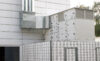
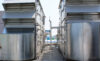
Rosenberg Airbox air handling units can be found worldwide in all areas of comfort air conditioning in residential and administrative buildings, hospitals, exhibition and conference centres, hotels and restaurants, museums and galleries, leisure centres, airports and many other areas.








Highest Energy Efficiency
The energy efficiency of an air handling unit is mainly determined by the air velocity in the clear cross-section of the unit and, as a result, the pressure losses at the components and the electrical power consumption of the fan, depending on the volume flow and pressure increase. In the case of a combined air handling unit with heat recovery (HR), the efficiency and pressure loss of the HR are also taken into account. When dimensioning the air velocities in the air handling unit, the electrical power consumption of the fans and the efficiency of the HR, we comply with the legal requirements of the Building Energy Act (GEG) and the requirements of the German Association of Manufacturers of Ventilation and Air Conditioning Equipment (RLT). The criteria of the RLT energy efficiency label comply with the DIN EN 13053:2020-05 standard. This standard defines seven air velocity classes from V1 to V7, five heat recovery classes from H1 to H5 and seven classes for fan power consumption from P1 to P7.
We determine the specific power consumption of a fan installed in a box air conditioner (SFPv) in accordance with the specifications of the current EN 16798-3.
Efficiency Classes according to RLT Guideline 01
Criteria | A+ | A | B |
|---|---|---|---|
Air velocity class without thermal air treatment | V5 | V6 | V7 |
Air velocity class with air heating and/or heat recovery | V4 | V5 | V6 |
Air velocity class with additional functions | V2 | V3 | V5 |
Air Velocity Classes
according to EN 13053 A1 (2011)
Class | Velocity [m/s] |
|---|---|
V1 | max. 1.6 |
V2 | > 1.6 to 1.8 |
V3 | > 1.8 to 2.0 |
V4 | > 2.0 to 2.2 |
V5 | > 2.2 to 2.5 |
V6 | > 2.5 to 2.8 |
V7 | > 2.8 to 3.2 |

Controls for Airbox air handling units
The controls, which are tailored to Airbox units, ensure maximum ease of use, safety and efficient operation. They are manufactured in accordance with VDE and EC guidelines and, together with the air conditioning units, form an optimal unit for maximum comfort with minimum energy consumption. The controller series are suitable for supply, room and exhaust air temperature control and control fans, standard motors, frequency converters and EC motors. Microprocessor-based technology ensures precise and reliable control.
Information Material
Here you will find information material and certificates relating to our Airbox air handling units.
- Air Handling UnitsCatalogues
Airbox T60 – Key facts
PDF, 1 MB - Air Handling UnitsCatalogues
Airbox S60 – Key facts
PDF, 1 MB - Air Handling UnitsCatalogues
Airbox F40 – Key facts
PDF, 1 MB - Certifications
Certificate according to Eurovent (Airbox)
PDF, 194 KB - Certifications
Certificate of hygiene compliance (Airbox T60)
PDF, 301 KB - Certifications
Certificate of hygiene compliance (Airbox F40)
PDF, 301 KB - Air Handling UnitsOperating- and Maintenance Manuals
Operating manual: Airbox S60 and T60
PDF, 4 MB